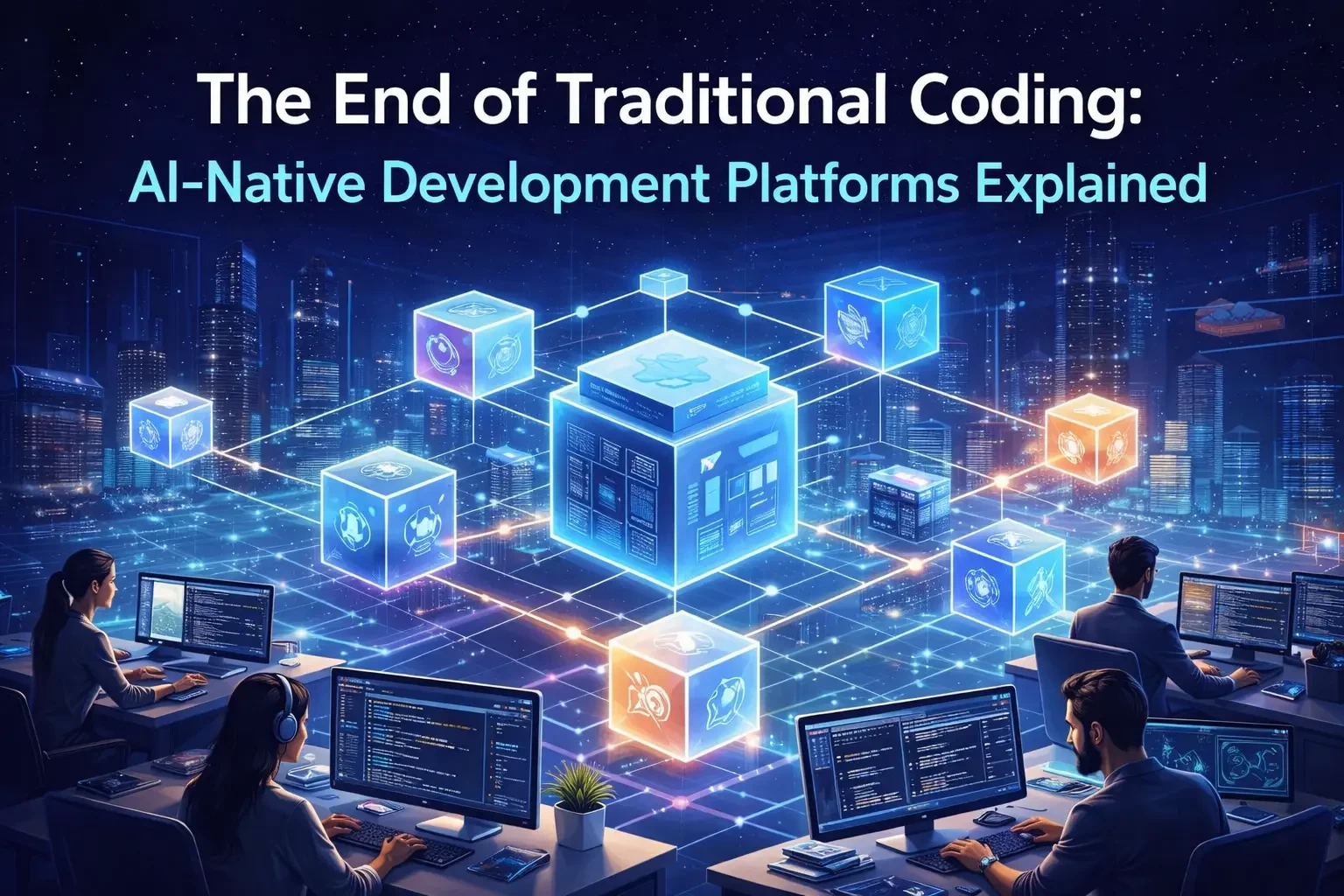
The End of Traditional Coding: AI-Native Development Platforms Explained
When I started professionally coding eight years ago, software development was all about hand-coding. Each and every feature had to be written line by line, and even small changes often required manually taxing work. One missing semicolon often broke everything, and debugging meant tracing logic step by step.
Over time, I have seen the development industry in the UK evolve with modern technologies. While programming has much older foundations, my experience was shaped by more recent changes. High-level languages, mature frameworks, and modern web development practices became the standard, significantly reducing manual effort.
Looking back across the last eight years of working in this space, one thing has stayed consistent through all of my experiences. Even with every improvement, most of the system was still being written manually. The tools changed, the speed improved, but the core process remained the same.
That started to change around 2020 to 2022, when AI began entering common software development processes in a more practical way. At first, it appeared in small forms like code suggestions, autocompletion, and basic assistance inside development tools. It didn’t feel like a shift in how software was built, more like an improvement in productivity.
But after 2022, especially with the rise of more advanced AI systems capable of generating full blocks of code and understanding structured instructions, the role of AI in development started expanding quickly. It moved from being a helper to something that could actively participate in building software.
This brings us back to the core idea behind this discussion: the end of traditional coding as we know it and the rise of AI-native development platforms that are reshaping how software is built today. In this blog, we explore what AI-native development platforms are and how they are changing software development today.
An Overview of AI-Native Development Platforms
AI-native development platforms can be defined as systems where AI is not just an add-on feature but plays an active role in building software. Instead of treating AI like a helper inside the development process, these platforms integrate it directly into how applications are designed, structured, and generated. In practical terms, this means I can describe what I want to build, and the platform can generate a working starting point. That includes frontend layouts, backend logic, API structures, and sometimes even basic testing setups. It is not replacing development completely, but it is changing how the first version of almost everything gets created.
In traditional software development in the UK, the process usually begins with planning, followed by writing code from scratch. In AI-native systems, that first draft is often generated, and the developer then refines and adjusts it based on requirements. This shift changes the role of the developer. Instead of spending most of the time writing repetitive code, we now focus on reviewing structure, correcting logic, and making decisions about architecture and flow.
How AI-Native Platforms Changes Software Development
I have personally seen how AI-native platforms in the UK have completely transformed the phenomenon of coding. Their impact significantly shapes how we structure and manage software development today, with more software development companies in UK adopting them in everyday operations. Here’s how AI-native platforms make a difference:
Development Moves Closer to Problem Definition: One of the most noticeable changes is where the effort goes. Instead of spending most of the time translating ideas into code, we now spend more time clearly defining the problem itself. The quality of input, whether it is prompts, requirements, or system instructions, directly affects the output.
Elimination of Large Development Cycles: In my experience, traditional software development followed longer cycles of planning, building, and testing. On the other hand, AI-native platforms support shorter, more flexible cycles where features can be generated, tested, and refined continuously.
Consolidation of Development Roles: The separation between frontend, backend, and testing roles is becoming less rigid. Since AI can generate across different layers of an application, developers are increasingly working across the full stack, especially in web development.
Emphasis on System Integration: As more components are generated quickly, the focus shifts toward making sure everything works together reliably. In this aspect, integration and system behavior have become more important than individual pieces of code.
Validation and Testing: This area is something I have observed a lot. With AI generating parts of the system, validating outputs becomes critical. Developers need to spend more time on verifying generated components, edge cases, and overall system stability.
The Hidden Risks of AI-Generated Code
While AI-native development platforms have made software development in the UK faster and more accessible, I have also noticed a few risks that are easy to miss, especially when the output looks correct at first glance. These common but hidden risks include:
Inconsistent Code Quality: One thing I have seen is how AI can generate the same type of feature in completely different ways. Over time, such behavior creates inconsistency across the codebase, making it harder to maintain and scale.
Lack of Context Awareness: AI generates code based on patterns, not full system understanding. I have come across cases where the logic works on its own but doesn’t fit well within the overall application flow or business requirements.
Hidden Performance Issues: In several web development scenarios, I have noticed that generated code works functionally but is not always efficient. Issues like unnecessary API calls or poor state handling only become visible when the application starts scaling.
Security Gaps: This issue is something that can easily be overlooked. AI-generated code may miss secure practices like proper input validation or access control. The application works, but small gaps can create serious risks in the long run.
Over-Reliance Without Understanding: The biggest risk I see in AI-native development platforms is dependency. When developers rely too much on generated code without fully understanding it, debugging and long-term maintenance become much more difficult.
Most Common AI-Native Development Platforms
While I’m still learning to unleash the full power of AI-native development platforms in the UK, the following are some of the best platforms I have come across and worked with:
GitHub Copilot
One of the earliest AI-native software development tools to gain widespread adoption, GitHub Copilot started as a code assistant but has gradually evolved into something more capable. In my experience, it goes beyond simple suggestions and can generate entire functions or logic blocks based on context.
ChatGPT and Similar AI Systems
Tools like ChatGPT have played a major role in changing how developers in the UK approach problem-solving. Instead of searching for solutions, I often find myself describing requirements and generating working code structures that can be refined further.
Replit Ghostwriter
Replit introduced AI directly into the development environment, making it possible to generate, modify, and run code in one place. This is particularly useful for rapid prototyping and smaller web development projects.
Cursor IDE
Cursor takes a slightly different approach by integrating AI deeply into the coding environment. It allows developers to edit, refactor, and generate code using natural language instructions, making the development process more interactive.
Low-Code and AI Builders (e.g., Bubble, Builder.ai)
Platforms like Bubble and Builder.ai are pushing AI-native development further by allowing applications to be built with minimal manual coding. These are especially relevant for non-developers or teams looking to build functional applications quickly.
The Future of Software and Web Development - The Shift Away from Traditional Coding
While AI-native development platforms are still relatively new, their impact is visible across both software development and web development, with companies gradually integrating them into their core operations and practices.
Beyond this point, what eight years in this industry have taught me is how development is moving toward faster prototyping, quicker structure generation, and more focus on refining outputs rather than building everything manually. Today, the core idea of fully manual coding no longer remains practical for most UK based development team. However, it still plays an important role in how people understand and maintain systems.
With AI-native systems on the rise, the role of the developer across the UK as well as the world is evolving and not simply disappearing. And this is precisely where the development industry currently stands, between established, traditional development practices and the emerging model of AI-native software development.
Related Blog